
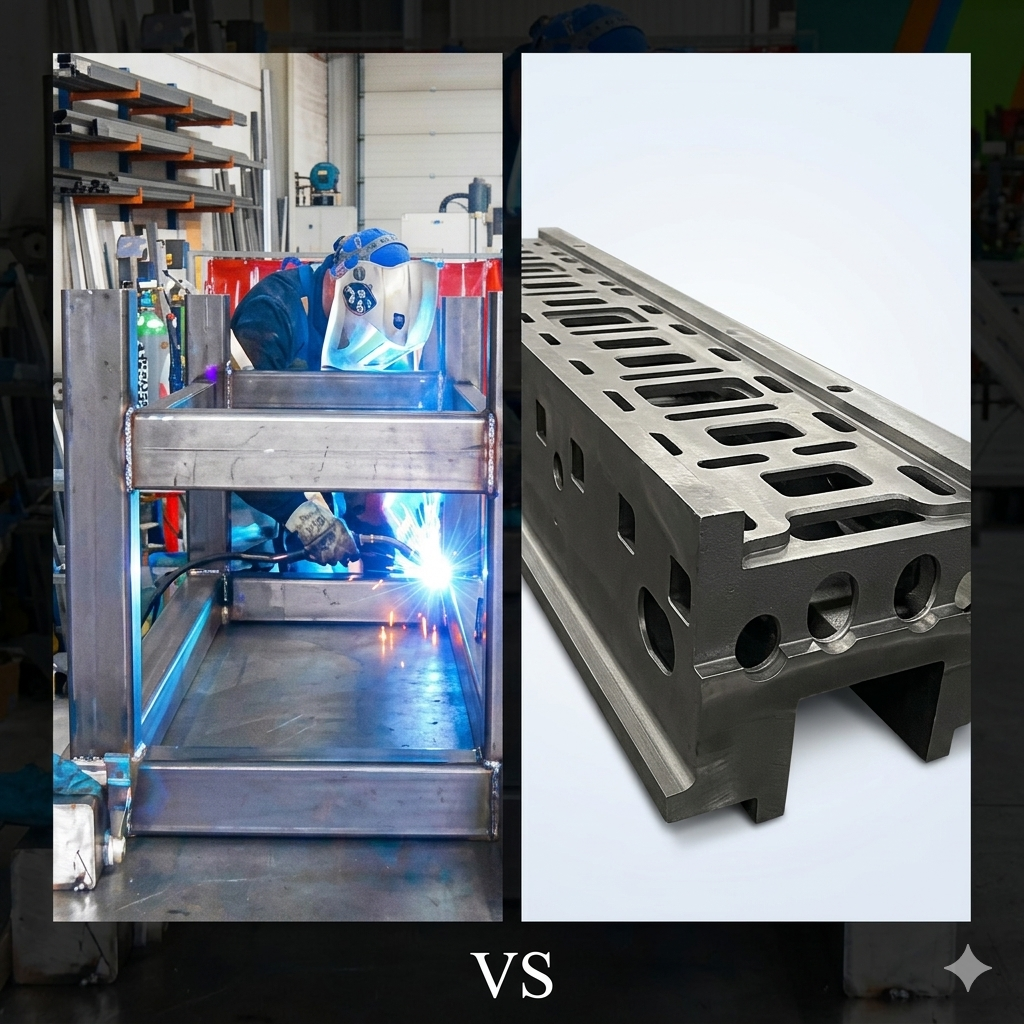
Weld-fabricated vs cast parts: which one to choose?
These are the advantages of weld-fabricated parts
- Better mechanical properties
- They are manufactured from rolled plates or profiles that typically have greater strength and toughness than many cast materials.
- Lower risk of internal defects such as porosity or shrinkage cavities.
- Lower weight
- The structure can be designed with optimised thicknesses and reinforcements, avoiding large solid masses.
- Simpler manufacture for large parts
- No giant moulds or large casting furnaces are required.
- They can be manufactured in sections and then welded together.
- Greater design flexibility
- It is easier to modify dimensions or add reinforcements during design or even during manufacturing.
- Ease of transport and assembly
- Large parts can be manufactured in modules and assembled afterwards.
- Easier repair
- They can be repaired by welding or replacement of sections.
However, cast components also have significant advantages:
Advantages of large cast parts
- Monolithic part (no welds)
- There are no weld beads, which can be critical areas if poorly executed.
- Complex shapes in a single part
- They allow very complex geometries with internal cavities or ribs.
- Good vibration absorption
- Some cast irons (such as grey cast iron) dampen vibrations very well, which is why they are used in machine tool beds.
We could draw the following conclusions from the above:
- For large and heavy structures (bridges, large frames, tanks, heavy machinery) it is generally better to opt for weld-fabricated parts.
- For complex, solid components or those that need to dampen vibrations, casting may be preferable.